Two of my primary interests in this life are agriculture and traveling. In the past few years, I have had the pleasure of combining those interests into one activity and calling it my job. Well, part of my job.
Back in the late 2010s my parents and some of their friends, who are FFA alumni and also enjoy agriculture and traveling, decided to try to start a travel program for FFA members. The goal was to offer international ag tours that would provide students an opportunity to see a variety of agriculture types and practices, be exposed to different cultures, and hopefully inspire in them a love of travel and a feeling that they are capable of it.
The group began to plan their inaugural tour: A fall 2020 trip to New Zealand. I was semi involved at the time – mostly just editing documents and creating sign up forms. All of the people involved were so excited about this first opportunity to get students on a plane and try this thing out. And then covid happened and we had to scrap the plans.
After waiting, along with the rest of the world, for travel to open back up, we decided to make the pilot trip domestic, instead of international. And because I have control issues, I accidentally became in charge. (Also because I have experience in event planning and the rest of the group was primarily retirees.)
Thus, our actual inaugural trip:
In February 2023 I, along with two chaperones, hauled 10 Oregon FFA members down the Central Valley of California and back up the Central Coast over the course of 8 days.
An Ag Tour of Central California
California is a powerhouse in US and world agriculture, producing more than 400 different commodities. In 2023 the state’s ag output totaled 59.4 billion dollars in cash receipts to farmers and ranchers. The same year, the state exported more than 22 billion dollars’ worth of agricultural products. The vastness and diversity of the state’s ag made it the perfect place to take a group of students. All we needed to do was connect with the right people to set up farm visits.
The network in agriculture is small – everyone knows someone who knows someone. I worked in California ag for three years, so I have a few contacts I could use. Neal Lucht, an Oregon FFA alum and owner of Northwest Transplants (and the best co-chaperones a girl could ask for), has a contact list a mile long from his decades of vegetable production. We started making calls and put together a tour representing a diverse cross section of the California ag industry.
When all was said and done, we logged over 1,000 miles while visiting 9 agriculture operations, an ag show, and an aquarium. Our route took us through the top six ag counties, which produced more than 37 of those 59.4 billion dollars.
DAY 1
The 10 students, myself, and two additional chaperones met up for orientation at a hotel near the airport. We spent the evening talking about tour expectations and goals, getting to know each other, and preparing to fly to California the next day.
DAY 2
We flew down to San Jose midday on Sunday so we could get our rental vans and drive to Modesto in time to get dinner, get some sleep, and be ready to start tours first thing Monday morning.
DAY 3
The tour started at Flory Industries, a family-owned manufacturer of nut harvest equipment. They design and produce harvesters for almonds, pistachios, chestnuts, hazelnuts, pecans, walnuts, and more. We were able to see all parts of the manufacturing process: plasma cutting, welding, powder coating, and assembly.
After Flory, we visited Hilmar Cheese Company. Students were able to make cheese in small groups and learn about the company. Hilmar produces cheese for private label, regional, and national brands. The cheese is packaged in 40- and 640-pound blocks and sent to companies to be repackaged with their own branding as slices, shreds, sticks, etc. There’s a strong possibility you’ve had Hilmar Cheese and just didn’t know it.
DAY 4
This day was spent at the World Ag Expo, a massive outdoor ag show in Tulare, California. With more than 1,200 exhibitors in a wide variety of industries, the students were able to see things they were all individually interested in. They spent the day in small groups, visiting booths and interacting with exhibitors. We went bowling this evening for a bit of non-ag fun.
DAY 5
You can’t learn about California agriculture without learning about their water and irrigation systems. On this morning we visited the Kaweah Delta Water Conservation District to gain a better understanding. We started with a visit in their main office and were later taken to see irrigation canals and infrastructure in an orchard.
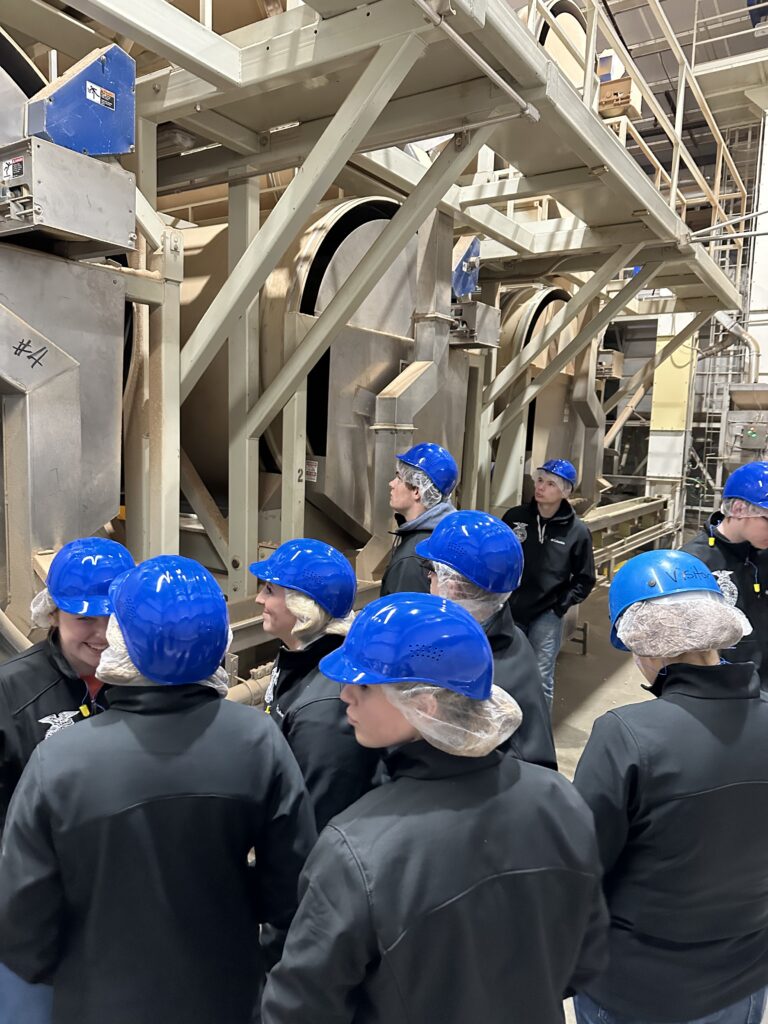
Next up was a very exciting visit to Nichols Farms where we learned about pistachio farming. Our tour took us through all the steps once the pistachios hit the processing plant from drying to packaging, and everything in between. The company gifted us hats and bags of pistachios, including their newly released flavors.
DAY 6
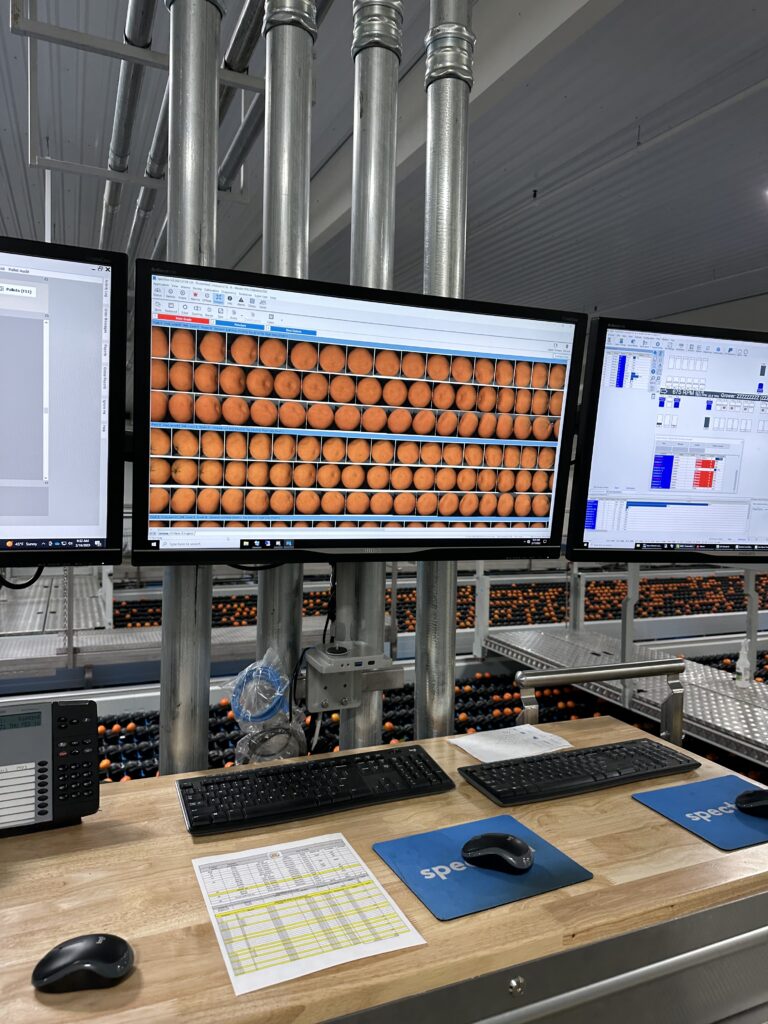
The morning visit took us to Porterville Citrus, facilities that process citrus that is then marketed under the Sunkist brand. We got to walk through a state-of-the-art mandarin processing facility as well as an older navel orange facility. It was incredibly interesting to see how the processing technology has advanced, including the 360 degree scanners in the facility that can sense and kick out fruit that doesn’t meet quality standards. We then visited a grove to see oranges being harvested and the students were able to pick some off the trees for themselves. The team at Porterville sent us on our way with 30 pounds of mandarins and two 70-count boxes of the best oranges we’d ever had.
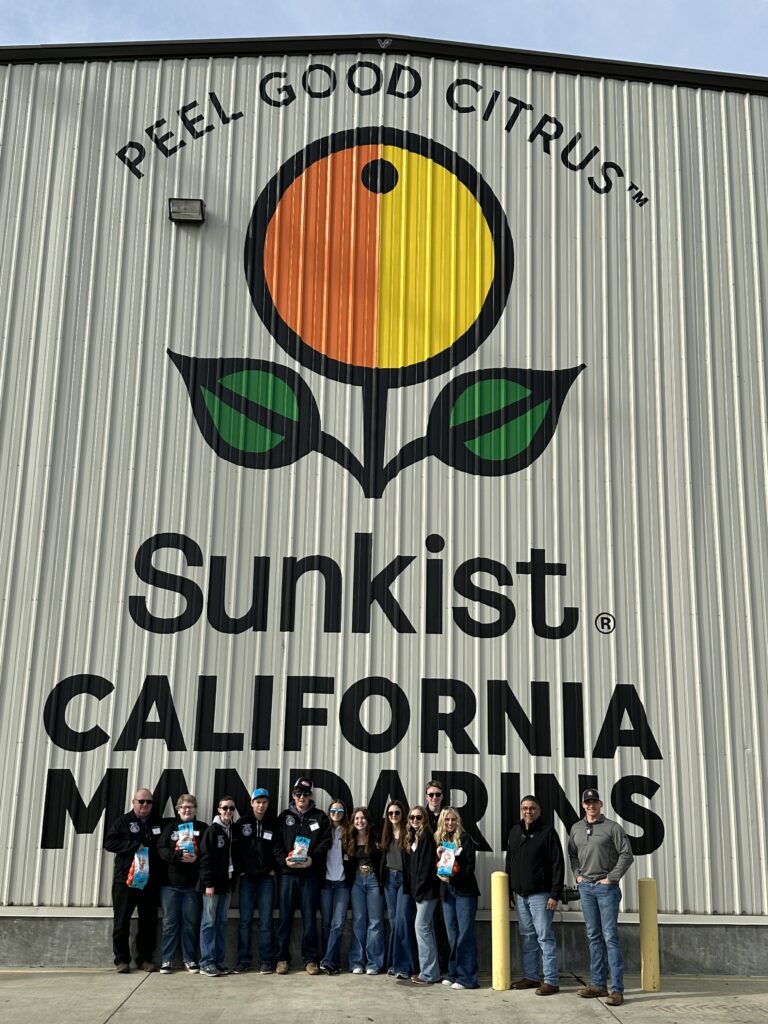
That afternoon we went to Sunridge Nurseries to learn about grape nursery stock production. We were able to see how they prep rootstock and then plant it in containers to grow in their greenhouses before it can be sold and planted in the ground. Sunridge has more than 600 acres of rootstock and 800,000 square feet of growing, grafting, and storage facilities and supplies grapevines worldwide.
DAY 7
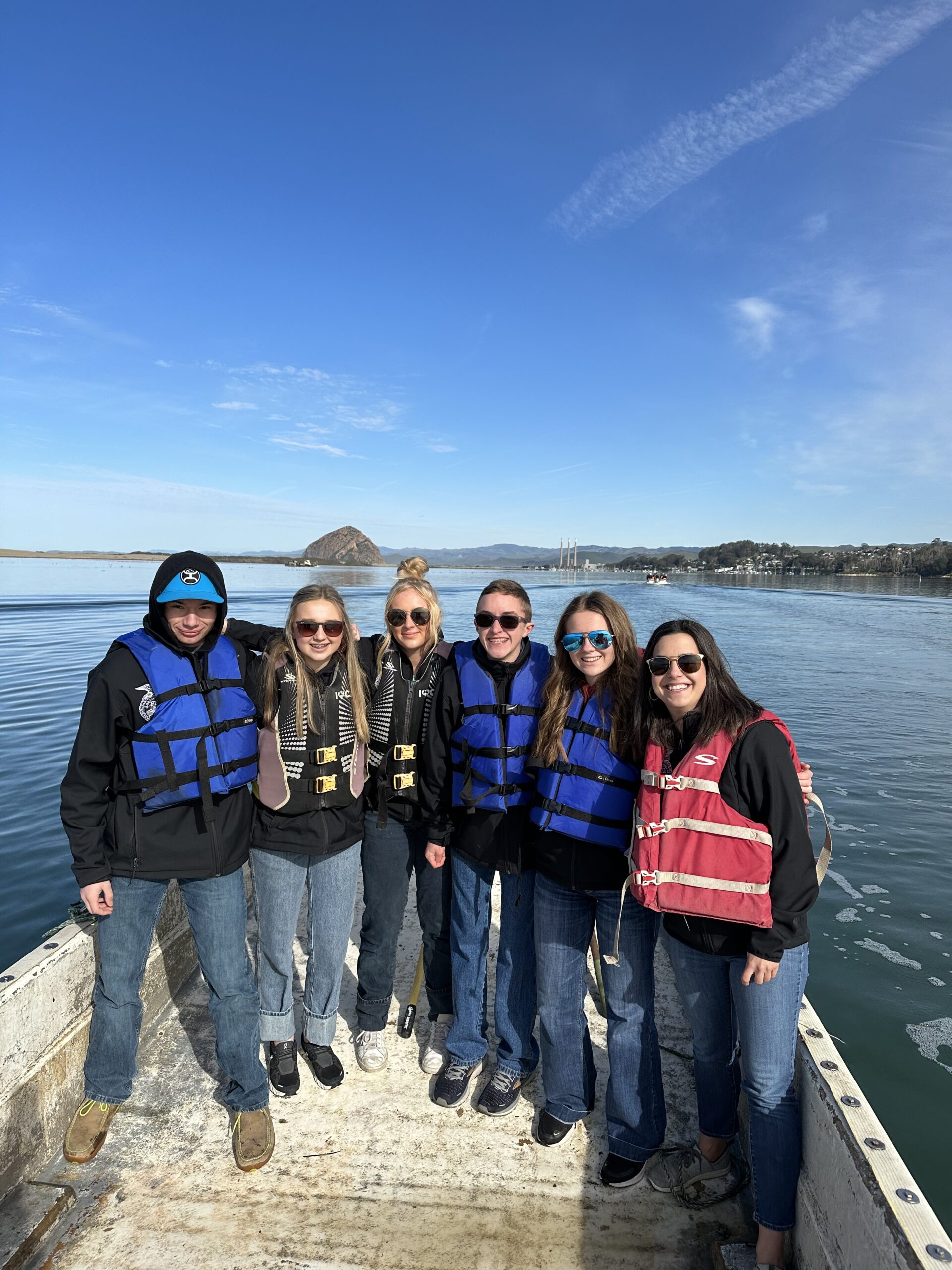
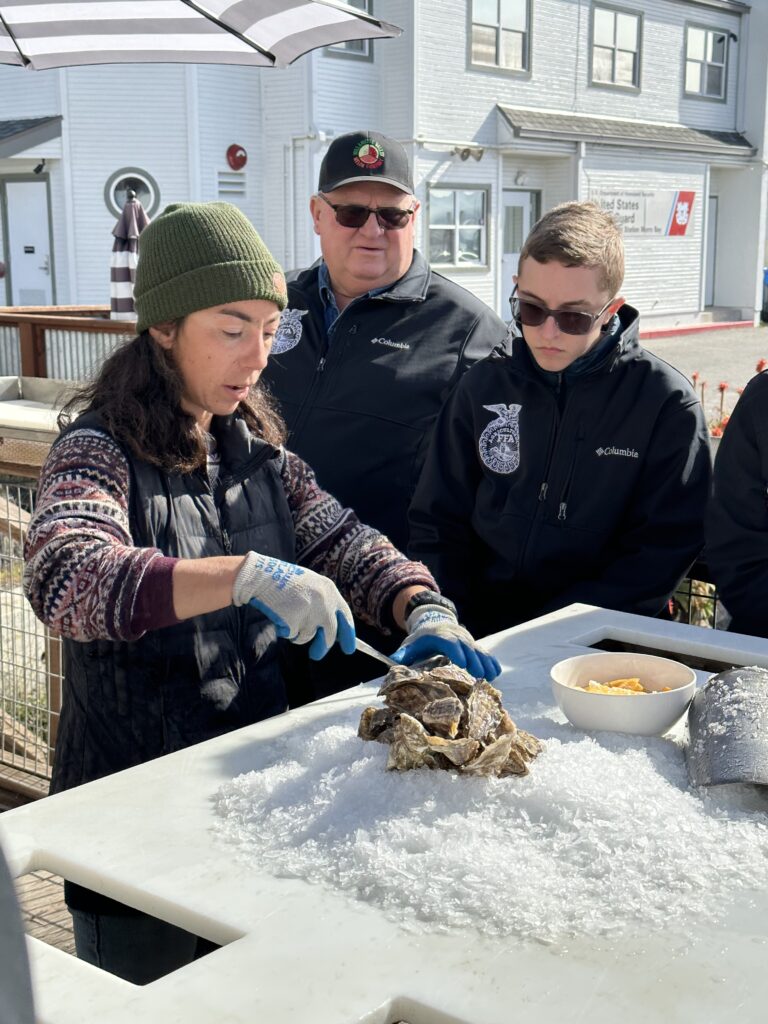
After finishing the Central Valley portion of the tour, we headed to the coast. We first visited Morro Bay Oyster Company for some aquaculture experience. Employees took us by boat to the part of the bay that houses the oyster farm. Students were able to see how the cages of oysters grow during that portion of their lifecycle and see how they are harvested. We were then taken back to their headquarters and fresh oysters were pulled out for us. They demonstrated how to shuck an oyster and proceeded to shuck enough for all of the students to sample. It was the first time trying oyster for most of them. Reviews were mixed.
In the afternoon we drove up to the Salinas Valley and visited Enza Zaden, an international vegetable-breeding company. We were invited to tour one of their research operations focusing primarily on onions. Students were able to talk to interns and researchers about what a career in plant research is like, as well as gain an understanding on how new varieties are developed.
DAY 8
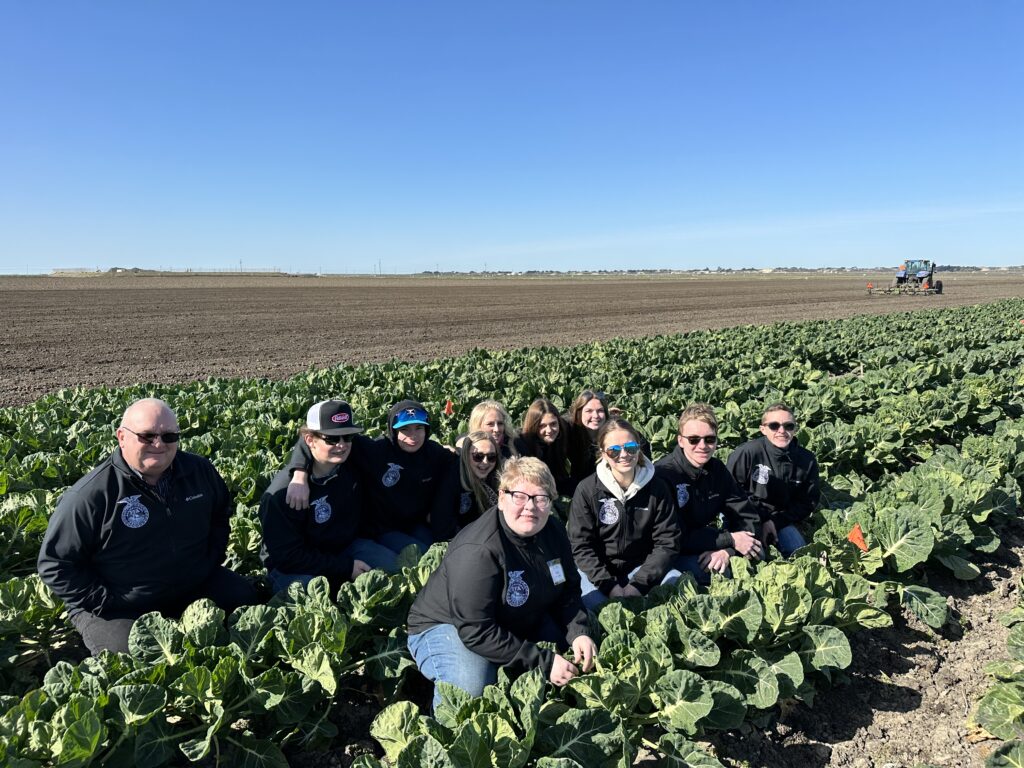
The morning of our final full day was spent in vegetable fields. We were able to watch spinach transplants being planted into the field and gain an understanding of that process. We then went to check out a Brussels sprouts trial with a representative of the company running the trial.
Afterward, we visited the Monterey Bay Aquarium. Students broke up into small groups to spend a few hours seeing what they each found most interesting. We then headed back to San Jose to stay close to the airport to fly home the next morning.
Our evening was spent writing thank you cards to all of the people who invited us to their operations, gave us tours, and supported our trip. We also spent a lot of time figuring out what to do with nearly 100 pounds of citrus.
DAY 9
We flew home from California dark and early. When we arrived back in Portland, we took a shuttle back to the hotel we stayed in before we went on the tour. Students were able to say their goodbyes and get picked up by their parents.
FFA members are some of the best teens you will ever meet
When I planned the tour, I was so deep in the logistics of making sure that those students were housed and fed and learned everything they could (and also made it safely back to their parents), that it did not even cross my mind to wonder what my interactions would be like with the students. What kind of relationship I would have with them. If I would have fun with them or not. It did not even enter the realm of thought.
But holy cow, did I have a good time with them.
Generally speaking, FFA members have strong work ethics, impressive interpersonal and professional skills, and are well spoken and courteous. They are responsible and respectful. There is a reason that many companies, including the one I was formerly with, donate a lot of money to the organization and recruit alumni into their workforce.
Multiple people who gave us tours or interacted with us in California mentioned how impressed they were with the group. They said the students were well behaved and asked great questions. That they engaged well. One person said he expected a bunch of rambunctious teens and was surprised by their good behavior.
As their group leader, I was very glad that their behavior was good, obviously. I needed them to be good. They were also fun. And funny, smart, friendly, and so much more. We developed inside jokes and they taught me new words. I was genuinely so happy to spend time with them.
They were also so good to each other
Two students had birthdays while on the tour. During a Walmart run one evening, I found a group of them in the party aisle, sneakily buying items to throw a birthday party that evening. I found them buying birthday gifts another time. I loved watching their relationships with each other grow.
The Inaugural Tour Has Led to More
Once California proved that tours can be planned and there are students who are interested in opportunities like this, our committee began to make more plans. We defined age ranges for different tour types and made a list of future destinations (with input from students as well). It was also decided to open up tours to students outside of Oregon.
We finally made it international too. I have since led trips to New Zealand and Italy. Those tours each deserve a post of their own, which will be coming.
There have also been a huge number of adults who have seen me advertising these tours and asked “When do we get one?!” Stay tuned for updates on that.
Check out the Ag Tour page on my site to learn more.
Leading these tours has become the absolute highlight of my job. I get to combine those ag and travel interests with my passion for FFA and education. Sometimes I have to pinch myself. The tour bucket list is long and only growing.
What is your dream ag tour destination? Let me know in the comment section below!
The California Ag statistics came from “2023 – 2024 California Agricultural Statistics Review. and can be found here.
*The California Ag Tour and all subsequent tours are privately facilitated and not programs of Oregon FFA or any other association.

Comments +